Cross-connection containment protects municipal water infrastructure across dense structural environments. In hillside single-family zones like Los Feliz and Silver Lake, elevation changes create backpressure scenarios…
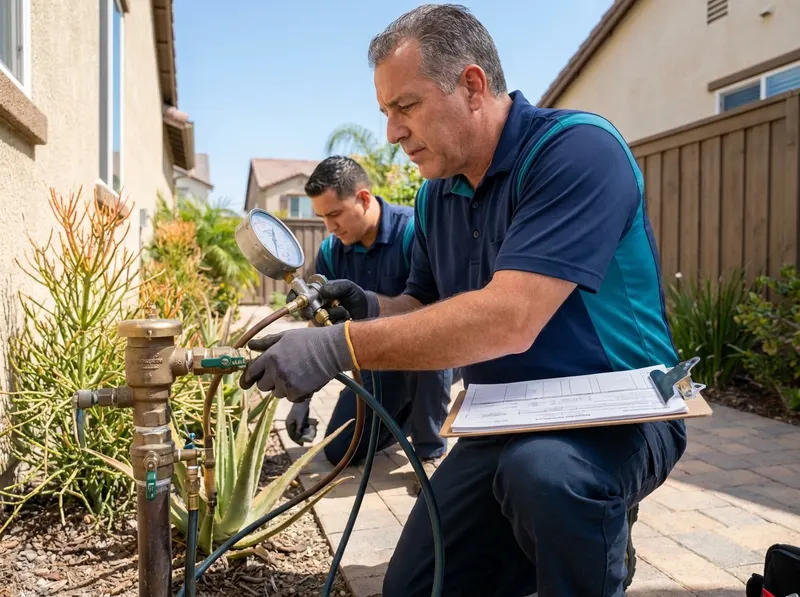
Cross-connection containment protects municipal water infrastructure across dense structural environments. In hillside single-family zones like Los Feliz and Silver Lake, elevation changes create backpressure scenarios when residential booster pumps overpower falling street pressure. Conversely, flat low-lying communities like Venice or multi-family corridors in Koreatown frequently face backsiphonage risks caused by high-demand water main draws or line breaks along arterial boulevards. Annual testing verifies that the internal mechanical springs, rubber disc seats, and relief valves isolate the potability boundary within precise factory tolerances. The certified diagnostic process relies on calibrated three-valve or five-valve differential pressure gauges accurate to 0.1 pounds per square inch (psi), ensuring every internal spring mechanism trips at the regulatory threshold.
Selecting the correct device configuration depends entirely on the degree of hazard present on the property. A Pressure Vacuum Breaker (PVB) suits continuous-pressure landscape irrigation loops on hillside parcels near Griffith Observatory or Elysian Park, yet it cannot withstand downstream backpressure. An industrial facility, commercial kitchen, or multi-family parcel in Studio City, Echo Park, or Hancock Park requires a Reduced Pressure (RP) device, which vents non-potable discharge directly to the atmosphere if hydraulic seals fail. While an RP device provides complete protection against both toxic hazards and backpressure, it requires adequate outdoor ground clearance and drainage capacity to manage intermittent purge discharges. A standard Double Check Valve (DC) remains appropriate only for fire suppression lines where no chemical additives exist.
The administrative chain of custody represents the final non-negotiable step in the compliance lifecycle. The Los Angeles Department of Water and Power (LADWP) and the Los Angeles County Department of Public Health issue strict thirty-day compliance windows via mailed testing notices. Failure to file certified test forms before the stated deadline triggers progressive enforcement, beginning with non-compliance administrative fees and escalating to physical water service disconnection at the street meter curb stop. To prevent utility disruptions, the certified inspector completes the physical pressure test, affixes the visible inspection tag to the bronze or cast iron housing, and submits the digital certification copy directly to LADWP's cross-connection control database.
Every job gets a firm, written price after a free on-site visit.
Tell us about your backflow prevention testing & certification job in los angeles and we'll send a clear, written quote, usually the same day.
 Los Angeles HandyPro